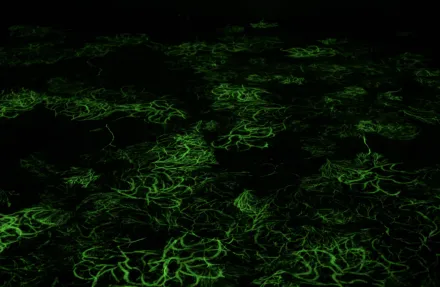
Good Lord Willin’, dimensions variable (20’x15’x5’) blacklight responsive screenprints on concrete, 2026
Research
My research centers on Appalachian resilience, shaped by my upbringing in rural East Tennessee. I draw connections between mycelial networks, the endangered species my biologist father studied, and Foofs—a rare, invented varmint species — treating each as a reflection of forms of life marginalized or displaced by systems of power. Through my work in printmaking, painting, and installation, I stay connected to the people and places I am thinking about. At the center of my practice is Appalachian Futurism: a forward-looking creative framework that moves beyond narratives of colonialism and exploitation to imagine new futures grounded in collective agency and possibility. Can a region whose histories have been extracted, caricatured, and repeatedly framed as obsolete imagine futures beyond merely subsisting? What does it mean to insist on a future?
I’ve been interested Donna Haraway’s ideas about futures. She proposes that survival in damaged worlds requires sustained engagement rather than escape. So, futurity becomes an ongoing reckoning with place: its ecological precarity and histories of extraction. To insist on a future is to stay with the trouble of it. I’m exploring these ideas through speculative strategies including queer visibility and ecological metaphor. I’m thinking about what queer rural futures look like, and how I can position forms of Appalachian life often rendered incompatible with the region as already embedded within its social and environmental fabric.
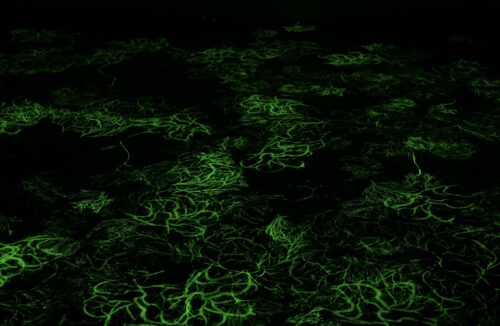
Good Lord Willin’, dimensions variable (20’x15’x5’) blacklight responsive screenprints on concrete, 2026