

Participatory Cognitive Mapping Workshop
MFA DRI Thesis
Beyond Carbon Neocolonialism: Participatory Mapping for Indigenous Sovereignty, Pluralistic Knowledge, and Decolonial Climate Justice
Abstract: Market environmentalists often champion carbon markets and offsetting as “effective” solutions to climate change, proposing the triple win for nature, economy, and social equity. Yet mounting evidence shows that they not only fail to deliver their promises but also enact neocolonial violence towards lands, bodies, and knowledge systems of Indigenous communities in the Global South. At the heart of such coloniality lies an entrenched epistemological bias in climate knowledge production: 1) the fragmentation of nature and society into separated domains; 2) the dominance of positivist techno-managerial frameworks; and 3) the hegemony of Western elite knowledge systems.
Grounded in scholarship on political ecology, human geography, and decolonial theories, this research highlights an alternative epistemological and methodological framework: 1) de-isolated, recognizing the interconnectedness of socioeconomic and ecological systems, the relationalities of all beings, and the intersectionality of violence; 2) de-positivist, centering emotions, reflexivity, spiritualities, somatic experiences, and lived knowledge from cultural practices and lands; and 3) de-colonial, amplifying participatory and collaborative methods, place-based alternatives, and the agency of local and Indigenous communities towards pluriversal world-making.
These principles culminate in a participatory mapping workshop, engaging faculty, university staff, and graduate students, whose academic knowledge and practices reflect diverse positions in climate governance. As a critical microcosm, participants collaboratively mapped their understandings, emotions, lived experiences, and embodied conflicts regarding carbon offsetting. Using words, drawings, and visual connections, they confronted market environmentalists with the neocolonial struggles of local groups, while amplifying alternative environmental stewardship rooted in equity, care, and respect. By emphasizing relational, embodied, and pluriversal epistemologies, the workshop offers a possible roadmap for decolonial climate justice that centers Indigenous sovereignty and pluralistic climate knowledge production.
Keywords: Carbon Market, Environmental Neocolonialism, Epistemological Bias, Plural Environmental Epistemologies, Participatory Cognitive Mapping, Workshop-based Research
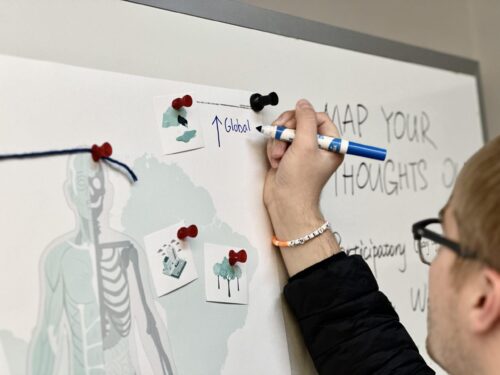
Participatory Cognitive Mapping Workshop